
YOU FOUND the perfect quartzite, quartz, granite or marble for your new countertops — congratulations! Now it’s time to choose the surface finish that will help determine its texture, shine, and performance, the real finishing touch!
There are three important factors to consider when choosing a countertop finish: 1) the look and feel; 2) maintenance, and; 3) your kitchen or room setting. Let’s take a look at the three most popular stone finishes, polished, honed, and leathered, and see how they compare in these three areas.
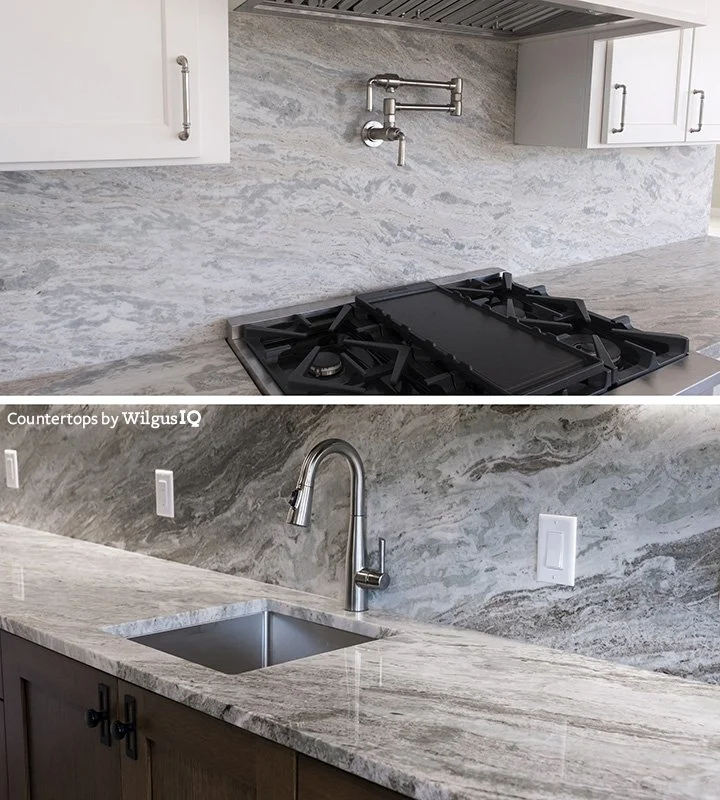
Fantasy Brown dolomitic marble with two different finishes, leathered (top) and polished (below). The difference between the muted look of leathered and the heightened color of the polished marble is striking. Countertops and photos by WilgusiQ.
How do polished, honed, and leathered finishes compare in look and feel?
Smooth and glossy, polished is still the most popular style of stone finish. To achieve this reflective surface, the surface is polished with diamond pads in a multi-step process. Polishing accentuates the stone’s natural colors, making them appear richer and deeper.
A honed or matte finish, while still smooth to the touch, removes the polished surface for a more muted look. With little or no sheen, a honed countertop has a more casual, natural appearance popular in contemporary kitchens.
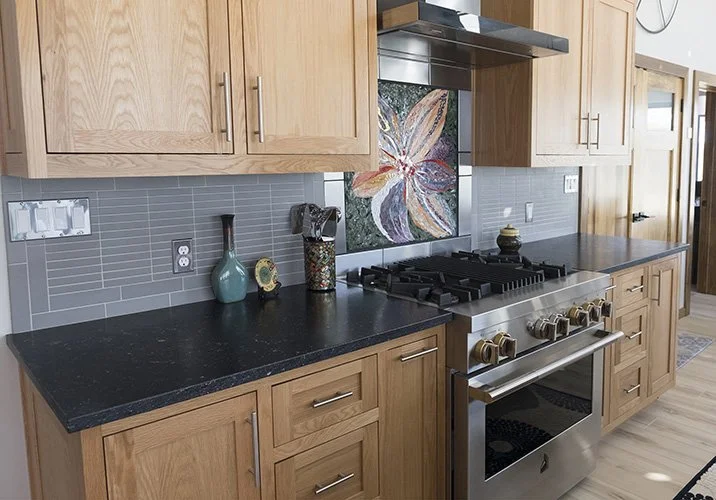
Honed Black Mist granite countertops complement the Boho feel of this Missouri lake home. Countertops and photo by WilgusIQ.
A feast for the fingers as well as the eyes, a leathered (sometimes called suede) finish “polishes the stone while leaving the natural contours and grooves intact,” explains Remodel Works. This allows you to feel as well as see the beauty of your stone. Since leathering leaves a matte-style finish, the colors are more subtle and natural.
“Some materials look phenomenal when you leather them, but others don’t,” cautions WilgusIQ owner Shane Wilgus. “It’s best to talk it over with your salesperson before you decide on the finish.”

This cattle ranching family chose a leathered Sunset Canyon granite to complement their Western decor. Countertops and photo by WilgusIQ.
How do polished, honed, and leathered finishes differ when it comes to maintenance?
The most hygienic, water and stain-resistant finish is polished. The extra polishing and buffing it receives helps close the stone’s natural pores. Being less porous, it’s easier to clean and doesn’t need to be resealed as often. On the other hand, the shinier surface is more likely to show fingerprints and crumbs.
Sealing a honed surface can protect it from spills, especially with a porous material like marble. Countertops and photo by WilgusIQ.
Cambria White Cliff Matte quartz. Photo credit Emily Henderson
A honed finish does a better job of concealing imperfections, but “the honing process leaves the stone's pores more open than a polished finish,” points out Carmel Stone Imports, making it more susceptible to liquids that can stain. Depending on the material, honed countertops may need more frequent sealing and a special matte sealer.
Engineered stone can be an exception to the rule, however. For example, Cambria’s Matte line of quartz is advertised as maintenance free and requires no sealing.
When it comes to maintenance, the uneven texture that makes a leathered finish so attractive can also make it more difficult to clean and more prone to chips and scratches.
How do polished, honed, and leathered finishes perform in different settings?
Since every room or area has a different size, style, and lighting scheme, it’s good to consider how your countertop finish will interact with the setting.
For example, “in an area with a lot of light,” observes Shane Wilgus, “you may not want a highly-reflective, polished finish. But if the room is dark, a polished finish can help lighten it.”
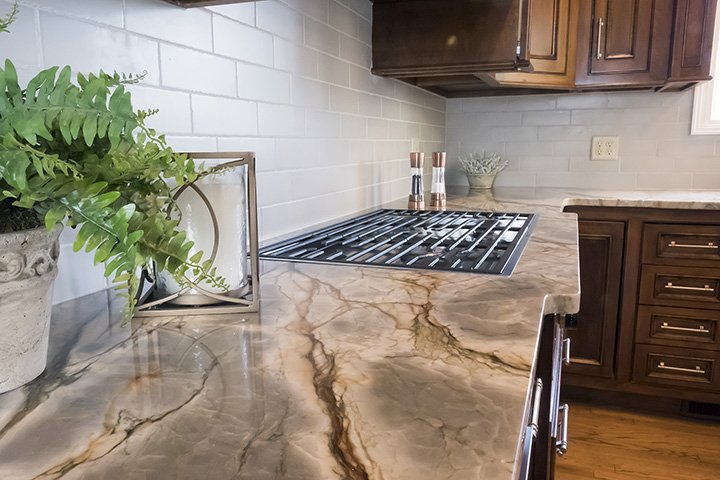
This kitchen’s darker palette is brightened by the polished surface of the Tempest quartzite that reflects both the light and the subway tile. Countertops and photo by WilgusIQ.
Are you working with a small space? A polished finish will make the room seem larger. “Reflective finishes,” notes Mary Kathryn Reese, “… help bounce light around the room, creating depth and dimension.”
Polished granite adds depth to this apartment space. Fabrication and photo by WilgusIQ.
Do you want to make a large space feel more cozy? A muted, honed finish might be just the thing.
Are you working with a space that is already rich in architectural detail, color or decor? A textured leathered finish may just add to the noise. But if your room features clean lines and neutral colors, a leather finish will pop like a cork!
If you would like personal assistance with choosing a finish, you are always welcome at the WilgusIQ showroom in Springfield, Missouri. There you can also browse our indoor and outdoor slab yards. For address and operating hours, please click the “Contact Us” button below.